
Plus500 Review
Plus500 is a globally recognized online trading platform that specializes in Contracts for Difference (CFDs) across multiple asset classes, including forex, stocks, commodities, indices, ETFs, options, and cryptocurrencies. Founded in 2008, the company has grown into one of the largest CFD providers worldwide and is publicly listed on the London Stock Exchange, which adds transparency and credibility to its operations.
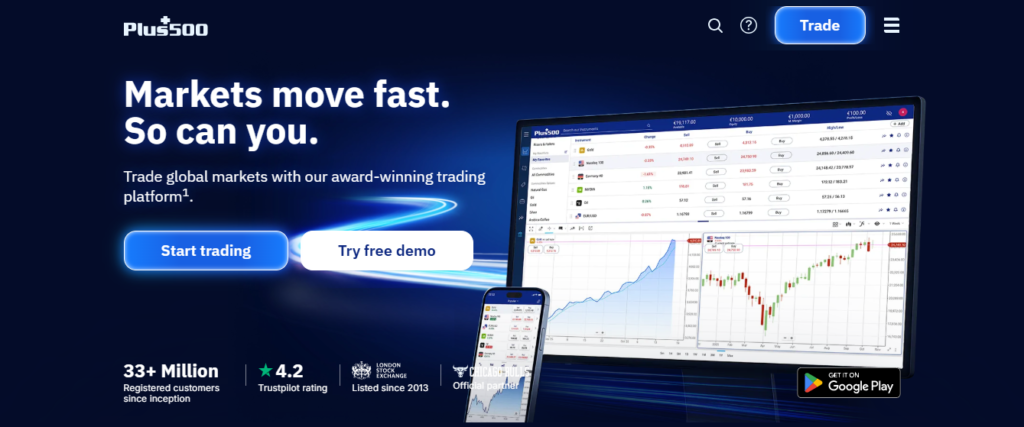
The broker is well known for its simple and user-friendly trading platform, making it suitable for beginners as well as traders who prefer a straightforward trading experience. Plus500 offers its own proprietary web and mobile trading platforms instead of third-party solutions like MT4 or cTrader, focusing on ease of use, fast execution, and integrated risk-management tools.
From a regulatory perspective, Plus500 is considered a well-regulated and relatively low-risk broker. The company operates under several top-tier financial authorities, including the Financial Conduct Authority (FCA), Australian Securities and Investments Commission (ASIC), Cyprus Securities and Exchange Commission (CySEC), Monetary Authority of Singapore (MAS), and others. These regulatory licenses ensure strict compliance with financial rules and provide additional protection for traders’ funds.
One of the key attractions of Plus500 is its commission-free trading model. Instead of charging traditional trading commissions, the broker mainly earns revenue through spreads—the difference between buy and sell prices. However, traders should be aware that other fees may apply, such as overnight funding charges, currency conversion fees, and inactivity fees if the account remains dormant for a long period.
The platform offers access to thousands of tradable instruments, allowing traders to speculate on global markets from a single account. With leverage available on certain products (depending on regulations and trader classification), Plus500 enables traders to amplify potential returns while also increasing risk exposure.
| Broker | Plus500 |
| Minimum Deposit | 100 USD |
| Swap Fees | Applicable swap fees/overnight financing |
| Leverage | Up to 1:30 for retail clients (varies by region) |
| Margin requirements | Varies by asset class typically between 2% to 5% |
| Fund Withdrawal Fee | None. Third-Party Fees may apply. |
| Commissions | None |
| Regulation and Security | Very High |
| Regulation | 🇬🇧 FCA 🇨🇾 CySEC 🇦🇺 ASIC 🇸🇬 MAS 🇸🇨 FSA 🇪🇪 EFSA 🇦🇪 DFSA 🇺🇸 CFTC |
| Negative balance protection | Yes |
| Investor Protection Schemes | Yes – Financial Services Compensation Scheme (FSCS) in the UK, and other local protection schemes |
| Account Segregation | Yes |
Plus500 Regulation & Safety
Plus500 is considered a well-regulated and trustworthy CFD broker, operating under multiple financial authorities across different regions. The broker’s parent company, Plus500 Ltd, is publicly listed on the London Stock Exchange, which requires strict financial transparency, regulatory reporting, and corporate governance standards.
Global Regulatory Licenses
Plus500 operates through several licensed subsidiaries that are supervised by reputable financial regulators worldwide. Key regulatory bodies include:
Financial Conduct Authority (FCA) – United Kingdom
Cyprus Securities and Exchange Commission (CySEC) – European Union
Australian Securities and Investments Commission (ASIC) – Australia
Monetary Authority of Singapore (MAS) – Singapore
Dubai Financial Services Authority (DFSA) – United Arab Emirates
Financial Markets Authority (FMA) – New Zealand
Financial Sector Conduct Authority (FSCA) – South Africa
Securities Commission of the Bahamas (SCB) – Bahamas
Seychelles Financial Services Authority (FSA) – International clients
These regulators oversee Plus500’s operations and enforce strict rules regarding financial transparency, client fund protection, and fair trading practices.
Client Fund Protection
To enhance trader safety, Plus500 follows several investor-protection measures:
Segregated Client Funds: Client deposits are held in separate bank accounts and are not mixed with the company’s operational funds.
Negative Balance Protection: Retail traders cannot lose more money than the amount they deposit in their trading accounts.
Investor Compensation Schemes: Depending on the entity managing the account, traders may be eligible for compensation programs (e.g., FSCS in the UK or ICF in the EU).
KYC & AML Compliance: Plus500 requires identity verification and follows anti-money-laundering regulations to ensure secure trading accounts.
Overall Safety
Thanks to multiple global licenses, strict regulatory oversight, segregated funds, and risk-management policies, Plus500 is widely regarded as a low-risk CFD broker for retail traders. However, as with any leveraged trading platform, traders should understand that CFD trading carries significant market risk and may result in the loss of invested capital.
Plus500 Trading Platforms
Plus500 provides traders with its own proprietary trading platform, designed to deliver a simple and intuitive trading experience. Unlike many forex and CFD brokers, Plus500 does not support third-party platforms such as MetaTrader 4 (MT4), MetaTrader 5 (MT5), or cTrader. Instead, the broker focuses on its in-house platform to maintain full control over features, execution, and platform performance.
Proprietary WebTrader Platform
The main trading platform offered by Plus500 is WebTrader, a browser-based platform that runs directly in modern web browsers like Chrome, Firefox, Safari, and Edge. Because it is web-based, traders do not need to download or install any software to start trading.
The WebTrader platform is designed with simplicity in mind and includes essential tools such as:
Real-time price charts and market data
Multiple order types
Advanced risk-management tools
Customizable watchlists
Price alerts and notifications
Integrated economic calendar and market insights
These features make the platform suitable for both beginners and casual traders who prefer a clean and easy-to-use trading interface.
Mobile Trading Apps
Plus500 also offers mobile trading applications for both Android and iOS devices, allowing traders to manage their accounts and execute trades from anywhere. The mobile apps provide nearly the same functionality as the WebTrader platform, including real-time quotes, charting tools, and price alerts.
Key mobile app features include:
Access to global markets and CFD instruments
Instant trade execution
Push notifications and price alerts
Account management and balance tracking
Economic calendar and market news
The mobile apps are highly rated in major app stores and are designed to deliver a smooth and responsive trading experience on smartphones and tablets.
Desktop & Multi-Device Access
Plus500’s trading platform is accessible across multiple devices, including web browsers, smartphones, tablets, and Windows applications, allowing traders to switch between devices without losing access to their accounts.
Overall Platform Experience
Overall, Plus500’s proprietary platform is known for its user-friendly design, fast execution, and built-in risk management tools. While it may not offer advanced algorithmic trading or MetaTrader compatibility, it remains a solid choice for traders who prefer a simple and streamlined CFD trading environment.
PU Prime Account Types
PU Prime offers several trading account types designed to meet the needs of different traders, from beginners to professional and high-volume traders. Each account provides access to the broker’s trading platforms, including MetaTrader 4 (MT4), MetaTrader 5 (MT5), WebTrader, and the PU Prime mobile app, along with access to global markets such as forex, commodities, indices, shares, and cryptocurrencies.
The main PU Prime account types include Standard, Prime, ECN, and Cent accounts, while some variants such as Islamic (swap-free) accounts are also available for traders who require Sharia-compliant trading conditions.
Standard Account
The Standard Account is designed for beginner and intermediate traders who want a simple trading experience with no commission fees. Trading costs are included in the spread, making it easier for traders to understand their trading expenses.
Key features:
Minimum deposit: around $50
Spreads starting from 1.3 pips
No commission on trades
Maximum leverage up to 1:1000
Minimum trade size: 0.01 lots
This account type is ideal for traders who prefer straightforward pricing without additional commission charges.
Prime Account
The Prime Account is suitable for experienced traders who prefer tighter spreads and faster execution speeds. This account provides raw spreads from liquidity providers, with a small commission charged per trade.
Key features:
Minimum deposit: around $1,000
Spreads starting from 0.0 pips
Commission about $3.50 per side per lot
Maximum leverage up to 1:1000
Minimum trade size: 0.01 lots
Prime accounts are often preferred by active traders, scalpers, and algorithmic traders who require tight spreads for frequent trading.
ECN Account
The ECN Account is designed for professional and high-volume traders who want direct market access and institutional-grade trading conditions. It offers very tight spreads and lower commissions compared to some other account types.
Key features:
Minimum deposit: around $10,000
Spreads starting from 0.0 pips
Commission about $1 per side per lot
Direct access to liquidity providers
Maximum leverage up to 1:1000
This account type is particularly popular among professional traders and high-frequency traders who rely on fast execution and deep liquidity.
Cent Account
The Cent Account is designed for beginners who want to start trading with a small investment while gaining real market experience. In this account type, the balance is displayed in cents rather than dollars, allowing traders to trade smaller positions with lower risk.
Key features:
Minimum deposit: around $20
Spreads starting from 1.3 pips
No commission
Account balance displayed in cents
Maximum leverage up to 1:1000
Cent accounts are ideal for new traders who want to test strategies with minimal risk before moving to larger accounts.
Islamic (Swap-Free) Account
PU Prime also provides Islamic accounts, also known as swap-free accounts, for traders who follow Islamic finance principles. These accounts remove overnight swap charges and instead apply an administrative fee when positions are held overnight.
Plus500 Account Types
Plus500 keeps its account structure relatively simple compared to many forex and CFD brokers. Most traders can choose between two main live account types, along with a demo account for practice trading. The availability of certain accounts may depend on the trader’s location and regulatory requirements.
1. Retail Account
The Retail Account is the standard trading account offered by Plus500 and is suitable for the majority of retail traders. It provides access to the broker’s full range of CFD instruments, including forex, commodities, indices, cryptocurrencies, stocks, and ETFs.
Key features of the Retail Account include:
Commission-free trading (costs included in spreads)
Negative balance protection for retail clients
Access to the Plus500 proprietary WebTrader platform
Multiple order types and risk-management tools
Leverage typically limited to 1:30 in regulated regions
This account is designed for everyday traders who want a simple and regulated CFD trading environment with built-in risk protections.
2. Professional Account
The Professional Account is intended for experienced traders who meet specific eligibility requirements. To qualify, traders generally need to meet at least two criteria such as a large investment portfolio, frequent trading activity, or professional experience in financial markets.
Professional accounts offer several advantages:
Higher leverage (up to 1:300 depending on the asset and region)
Potential rebate programs
Access to the same trading instruments and platform as retail accounts
However, professional traders may lose some protections that retail traders receive, such as participation in certain investor compensation schemes.
3. Demo Account
Plus500 also provides a free demo account that allows traders to practice trading with virtual funds in real market conditions. The demo account replicates the same trading environment as a live account but without financial risk.
Main features include:
Unlimited usage with no time restrictions
Virtual funds for risk-free practice
Access to all platform tools and trading instruments
Ability to switch easily between demo and live accounts
This account is ideal for beginners who want to learn the platform and test trading strategies before committing real money.
Additional Account Options
In some regions, Plus500 also offers specialized account types such as:
Islamic (Swap-Free) Accounts for traders who require Sharia-compliant trading without overnight interest charges.
Invest Accounts for trading real stocks without leverage in eligible countries.
Futures Accounts available primarily to U.S. traders for futures market trading.
Plus500 Fees, Spreads & Commissions
Plus500 follows a commission-free trading model, meaning traders do not pay a direct commission when opening or closing trades. Instead, the broker primarily earns revenue through the spread, which is the difference between the buy (ask) and sell (bid) price of an asset.
Overall, the fee structure is considered transparent and simple, although traders should still be aware of certain trading and non-trading charges that may apply depending on their activity and the instruments they trade.
Spreads
The main trading cost at Plus500 is the variable spread applied to each instrument. This spread is already included in the quoted market price, so traders do not pay an additional fee beyond the bid-ask difference.
Spreads vary depending on market conditions, asset type, and liquidity. For example:
EUR/USD: around 0.6 – 0.8 pips on average
Gold: around 0.3 – 0.4
Major indices: typically around 0.7 points or more
Because spreads fluctuate with market volatility, trading costs may increase during major economic events or periods of low liquidity.
Commission Structure
Plus500 does not charge trading commissions on most CFD instruments. This makes the pricing structure straightforward compared with some brokers that charge both spreads and commissions.
However, traders should remember that wider spreads can sometimes compensate for the absence of commissions.
Overnight Funding (Swap Fees)
When a trader keeps a leveraged CFD position open overnight, Plus500 may apply an overnight funding fee, also known as a swap or financing charge. This fee represents the cost of maintaining a leveraged position and varies depending on the asset and market interest rates.
In some cases, traders may receive a small credit if the overnight rate is positive, but this depends on the instrument and trading direction.
Currency Conversion Fee
If a trader trades instruments denominated in a currency different from their account currency, Plus500 applies a currency conversion fee. This fee can be up to approximately 0.7% of the trade’s net profit or loss and is reflected in the account balance in real time.
Inactivity Fee
Plus500 charges an inactivity fee of up to $10 per month if a trader does not log into their account for a period of three months or more. This fee continues monthly until the trader logs in again or the account balance reaches zero.
Deposit & Withdrawal Fees
Plus500 generally does not charge fees for deposits or withdrawals, which makes fund management relatively convenient for traders. However, banks or payment providers may apply their own transaction or currency conversion charges.
Plus500 Education
Plus500 provides a range of educational resources designed to help beginners and intermediate traders understand financial markets and improve their trading skills. The broker offers learning materials through its Trading Academy, which includes articles, videos, guides, and practical tools to help traders learn about CFDs, market analysis, and risk management.
Although the educational library is not as extensive as some large brokers, it still offers useful learning content that can help traders understand how online trading works.
Trading Academy
The Plus500 Trading Academy serves as the broker’s main learning center. It contains a collection of guides, educational articles, and tutorials that explain different aspects of trading.
Topics covered in the academy include:
Basics of CFD trading
Forex, commodities, and stock trading guides
Risk management and trading psychology
Platform tutorials and order types
Technical analysis concepts
These resources are designed to help traders build a strong foundation before entering live markets.
Video Tutorials & Trader’s Guide
Plus500 also offers educational videos and tutorial series, often referred to as the Trader’s Guide. These videos explain important trading concepts such as margin, leverage, order types, and price movements.
Video lessons typically cover topics like:
What is CFD trading
How to use the Plus500 trading platform
Understanding spreads and leverage
Risk-reward ratios and trading strategies
The tutorials are available on the broker’s website and official YouTube channel, making them easily accessible for traders.
Educational Articles & eBook
In addition to videos, Plus500 provides written educational content, including detailed articles and an eBook. These materials explain trading instruments, platform features, and key financial terms in a structured way.
The articles cover subjects such as:
Trading basics for beginners
Understanding financial markets
Technical indicators and chart patterns
Market terminology
These guides are helpful for traders who prefer reading and learning at their own pace.
Webinars & Market Insights
Plus500 occasionally hosts educational webinars and market analysis sessions, where traders can learn about market trends, trading strategies, and economic events affecting global markets.
Webinars often include discussions on:
Market volatility and economic events
Trading strategies and technical analysis
Risk management techniques
Some advanced webinars may be available only to certain account types or premium users.
Demo Account for Practice
One of the most valuable educational tools offered by Plus500 is its free demo account, which allows traders to practice trading using virtual funds in real market conditions.
The demo account helps traders:
Learn how the trading platform works
Test trading strategies without financial risk
Practice order execution and risk management
Plus500 Customer Support
Plus500 offers 24/7 customer support to assist traders with account issues, platform questions, deposits, withdrawals, and general trading inquiries. The broker mainly provides support through online channels, allowing users to contact the support team directly through the platform or website.
Live Chat Support
The live chat feature is the fastest way to contact Plus500’s support team. It is available directly on the website and inside the trading platform, allowing traders to connect with a support representative instantly.
Key features of live chat support include:
Available 24 hours a day, 7 days a week
Quick responses to account and trading questions
Direct access from the platform interface
Suitable for urgent issues or quick assistance
Live chat is generally considered the most efficient support method, as responses are usually immediate.
Email Support
Traders can also contact Plus500 through email or the online contact form available on the broker’s website. This option is useful for more complex issues that may require detailed explanations or document attachments.
Typical uses for email support include:
Account verification issues
Withdrawal or deposit inquiries
Technical platform problems
General account management requests
Email responses are usually delivered within 24 hours depending on the request.
Help Center & FAQ Section
Plus500 also provides a comprehensive Help Center and FAQ section on its website. This resource covers common questions related to trading accounts, deposits, withdrawals, fees, and platform features.
The FAQ section helps traders quickly find answers without contacting customer support.
Additional Support Channels
In some regions, Plus500 may also offer WhatsApp support and other messaging options through its contact page.
However, one limitation of Plus500’s support system is that telephone support is generally not available, as the broker mainly focuses on online support channels.
Plus500 Pros & Cons
Pros
1. Strong Global Regulation
Plus500 is regulated by several reputable financial authorities such as the FCA (UK), ASIC (Australia), and CySEC (Europe). The company is also publicly listed on the London Stock Exchange, which adds transparency and credibility.
2. User-Friendly Trading Platform
The broker offers a simple and intuitive proprietary platform that is easy to navigate, making it suitable for beginners and casual traders.
3. Commission-Free Trading
Plus500 generally does not charge trading commissions on CFDs. Instead, most costs are included in the spread, which simplifies the pricing structure.
4. Wide Range of Tradable Instruments
Traders can access 2,800+ CFD instruments, including forex, stocks, commodities, indices, cryptocurrencies, and ETFs from a single account.
5. Free Unlimited Demo Account
Plus500 provides a demo account with virtual funds, allowing beginners to practice trading and test strategies without financial risk.
6. Strong Mobile Trading Experience
The Plus500 mobile app is well-designed and widely praised for its smooth performance and ease of use.
Cons
1. No MetaTrader (MT4/MT5) Support
Plus500 only offers its proprietary trading platform and does not support popular third-party platforms such as MT4 or MT5, which some advanced traders prefer.
2. Limited Advanced Trading Tools
The platform lacks advanced features like automated trading, algorithmic trading, and deep fundamental research tools.
3. High Overnight Funding Fees
Holding leveraged CFD positions overnight can result in relatively high financing charges compared to some competitors.
4. Limited Educational Resources
Although the broker provides basic learning materials, its educational content is less extensive compared to major forex brokers.
5. Mainly CFD Trading
Most instruments on Plus500 are CFDs, meaning traders do not own the underlying asset. This may not suit investors looking for direct asset ownership.
Plus500 Conclusion
Overall, Plus500 is a well-known global online trading platform that focuses mainly on CFD trading across multiple financial markets, including forex, stocks, indices, commodities, and cryptocurrencies. Founded in 2008 and listed on the London Stock Exchange, the company has grown into one of the major online trading providers worldwide.
The broker stands out for its simple and user-friendly proprietary trading platform, which allows traders to access thousands of CFD instruments from a single account through web and mobile devices. Its commission-free trading model and transparent pricing structure make it attractive for beginners and casual traders who prefer a straightforward trading environment.
Another key advantage is the broker’s strong regulatory framework, as Plus500 operates under several international financial authorities. This regulatory oversight helps ensure compliance, client fund protection, and operational transparency, which increases overall trust in the platform.
However, Plus500 may not suit every type of trader. The platform does not support MetaTrader platforms (MT4/MT5) or advanced algorithmic trading tools, and most of its offerings are CFDs, meaning traders do not own the underlying assets. Additionally, some costs such as overnight funding fees may apply when holding leveraged positions for extended periods.